
Inventory Automation for a Laptop Remanufacturer
A consultation that mapped every process in a fast-growing remanufacturing business, then the systems that came out of it: AI-assisted inventory categorisation on top of Microsoft Dynamics, and barcode scanning on the inbound dock.
A business growing faster than its processes
Around 160 million laptops are manufactured every year. A2C, through its Circular Computing brand, takes used ones and remanufactures them to near-new condition for resale. It is a good business and it grew quickly, sharply so during the lockdown period when demand for laptops spiked.
Growth like that exposes every manual step. Thousands of machines arrive a day, each one a slightly different specification, and every one has to be identified, categorised and moved through the warehouse before it can be sold. The processes that worked at a smaller scale had become the constraint.
We were brought in to lead the digital transformation. Not to build a specific system, at first, but to work out which systems were worth building.
Map every process before building anything
The consultation went department by department. For each process we recorded what it was, how long it took, where its data lived and which systems touched it. It was exhaustive by design: an optimisation plan built on a partial view of the business optimises the wrong things.
With the map complete, the opportunities were plain to see. We grouped them by department and by the system that would address them, three of which we proposed: a supplier portal, a warehouse management system and a sales portal. Each came with a return-on-investment calculation showing how long it would take to pay back its build cost through hard savings, chiefly the staff the business would otherwise have to hire as it grew.
proposed supplier portal · warehouse management system · sales portal
justified ROI per system · payback from hard savings as the business scales
The first priority that fell out of the analysis was not the most glamorous. It was the categorisation of inbound inventory, because that was where the hours were going.
Doing the analysis first meant that when we did start building, nobody had to argue about why.
Teaching the system to categorise stock
A2C’s inventory lives in Microsoft Dynamics, and Dynamics is where it stays. We built a system alongside it, integrated through the Microsoft API, so that every item imported into Dynamics passes through the new platform on its way in.
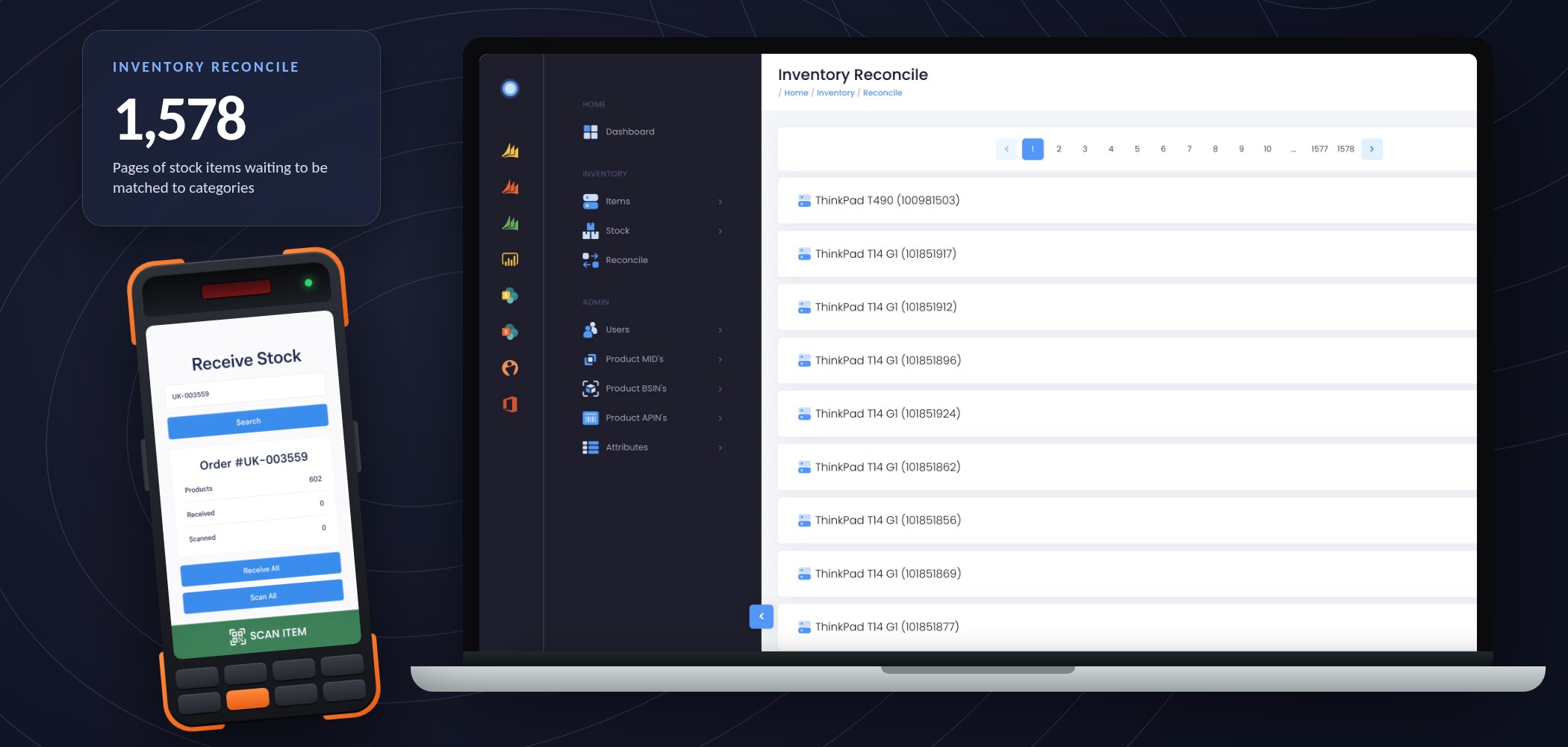
Administrators see each item with its raw attribute text, make, model, processor, generation, chassis, and align it to the attribute values and categories the business sells by. As they work, the system builds models of their decisions. Once it has seen a pattern enough times it reconciles matching items on its own, and the queue that needed a person for every laptop needs one for the exceptions.
Every inbound machine categorised by hand in Dynamics, attribute by attribute, thousands a day, by people who could have been doing something else.
Items matched against learned attribute patterns as they import; administrators confirm or correct, and every correction trains the next match.
Attributes are the product
A remanufactured laptop is sold on its specification, so the attribute data is not metadata, it is the listing. Processor type and generation, RAM, graphics, Wi-Fi standard, adapter type: get one wrong and a customer receives something other than what they ordered.
The platform holds the attribute vocabulary the business sells by and maps every incoming value onto it. Where a value has no match it is flagged rather than guessed. New attribute data arrives in bulk by CSV, validated on import, with every batch recorded: how many attributes, how many imported, how many failed and why.
The dashboard shows what that produces: total stock, the top products by volume, and the share of inventory that is live, pending or has failed to export back to Dynamics, with an audit trail on both items and attributes.

Scanning the inbound dock
A second, deeper analysis of the warehouse found the next bottleneck in inbound order processing: stock arriving on pallets, checked against purchase orders by hand, and the results keyed into Dynamics afterwards. We built an app for Zebra barcode scanners and rolled it out across the inbound team. Operatives scan pallets and individual units as they land; the app checks what arrived against what was ordered and pushes the result into Dynamics without anyone typing it.
Inbound stock counted and checked against orders on paper, then re-keyed into Dynamics later in the day.
Pallets and units scanned on the dock, reconciled against the order on the spot, Dynamics updated as the scan completes.
Warehouse software succeeds or fails on whether people on the floor will use it. Purpose-built scanner hardware, one screen, one job, was the right call over a phone app here.
Integrate with what they already run
None of this replaced Dynamics. The ERP remained the system of record, and everything we built either fed it or read from it. That is a deliberate stance: a growing business rarely needs a new core system, it needs the manual work around the core removed.
The same applies to the CRM and the scanners: we fixed and connected what was there before proposing anything new, which is what the client’s own summary of the work reflects.
It also kept the ROI honest. Every system on the roadmap was costed against the staff it would save, not against the appeal of a rebuild.
Where it stands
The initial project is complete and we continue to support A2C’s systems as their technical partner, so the team can concentrate on remanufacturing rather than on the software that tracks it.
The order of work mattered as much as the work itself: analysis, then the highest-volume manual process, then the next one. Each system paid for the conversation about the one after it.
Your operations have outgrown the spreadsheet.
We start with the process map and the ROI, then build the systems that pay for themselves: integrated with what you already run, automated where the volume is, and supported by a partner who stays.
.avif)