
A White-Label Innovation Portfolio Platform, Built to Run Anywhere
OUTCOME sells a method for running corporate innovation like an investment portfolio. Satori is that method as software — and it had outgrown the code beneath it. We rebuilt it as one containerised platform that ships as a private, branded instance for each corporate client, on their own infrastructure if that is what their security team requires.
A product that had outgrown the code beneath it
OUTCOME is an innovation consultancy whose founders have written the books on how large organisations should run internal ventures: as a portfolio, stage by stage, with the money accounted for the way an investor would account for it. Satori is that method turned into software and sold to corporates.
When they came to us the product already existed, built by a previous team, and it was fragile. Staging fell over, the database dropped connections, and the version their clients had been shown was not the version the code was on. They had corporate prospects lining up and a platform they could not confidently demonstrate.
We took the codebase in early 2023, containerised it, and rebuilt the parts that were holding it back: a new front end, a stabilised API, proper database migrations and a repeatable release process. Then we built the product forward.
Running internal ventures like a portfolio
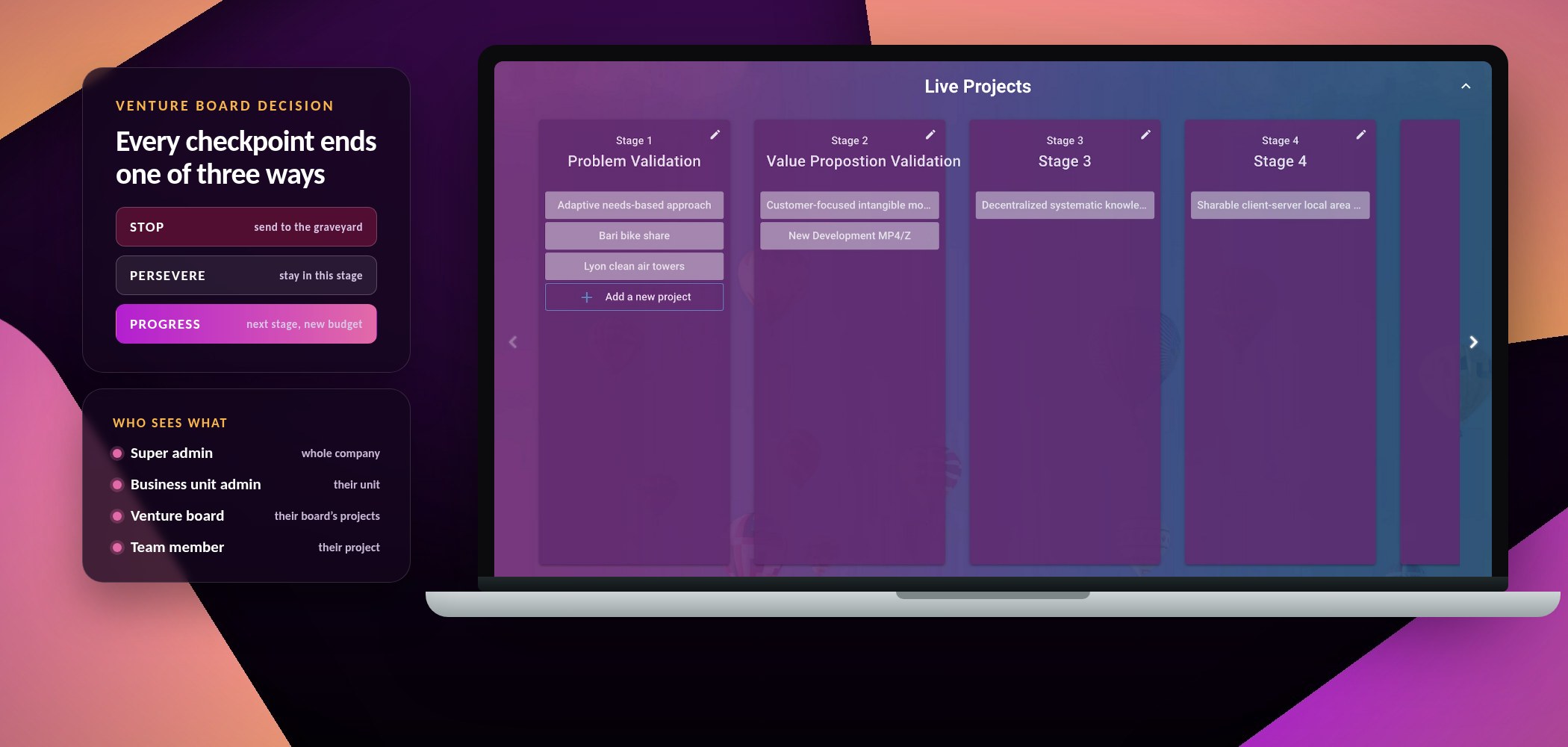
A corporate innovation team might have forty ideas in flight. Satori puts them in a funnel with defined stages, and at the end of each stage a venture board sits down with the team, reviews the evidence and makes one of three calls: stop the project and send it to the graveyard, persevere in the current stage, or progress it to the next one with a new budget.
Everything in the product exists to make that meeting honest. Key success factors are scored with a confidence level and backed by evidence. Budgets are allocated per stage and tracked in both money and man-hours. Sessions are scheduled with calendar invites to the whole board, so the decision happens on a date rather than eventually.
after a stage-gate funnel · scored evidence · budgets tracked in money and hours
outcome every board decision recorded against the numbers that justified it
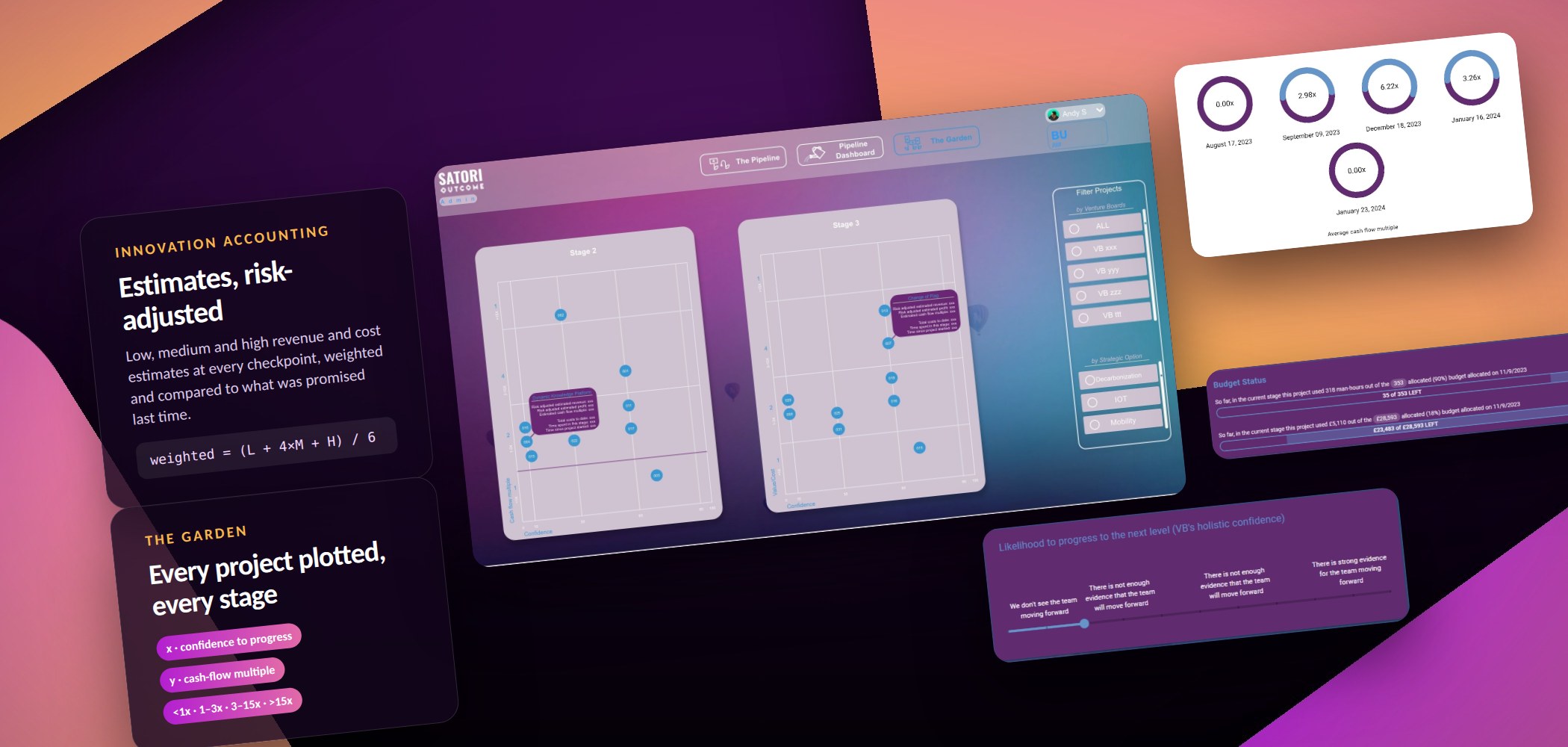
The Garden plots every project on two axes — how confident the board is that it will progress, against its estimated cash-flow multiple — so a portfolio of forty ventures reads as one picture instead of forty documents.
Funnel-level indicators sit on top: average time to clear a stage, average cost of failure, average time to kill, conversion rate through the funnel, total cost of innovation. That dashboard is the part corporates buy, and the part that is nearly impossible to produce by hand.
Making the case for killing things early
Most corporate innovation programmes cannot tell you what they spent to find out that an idea would not work. Satori can. Cost of failure, average time to kill and total cost of innovation are first-class numbers, calculated from the budgets and hours already recorded against each stage of each project.
The maths was specified by OUTCOME and implemented precisely: low, medium and high estimates weighted into a single figure, risk-adjusted against the board’s confidence score, expressed as a cash-flow multiple, with unspent budget carried between stages and actual revenue reported back against what was forecast.
A portfolio review assembled from slides, with every team presenting its numbers its own way.
One set of formulas applied to every project, with the previous estimate shown beside the current one.
One product, many badges
The business model was never to sell licences one at a time. It was to place Satori inside large organisations that expect the software they use to look like theirs. So white-labelling could not be a theme switcher bolted on at the end — it had to be how the product was built.
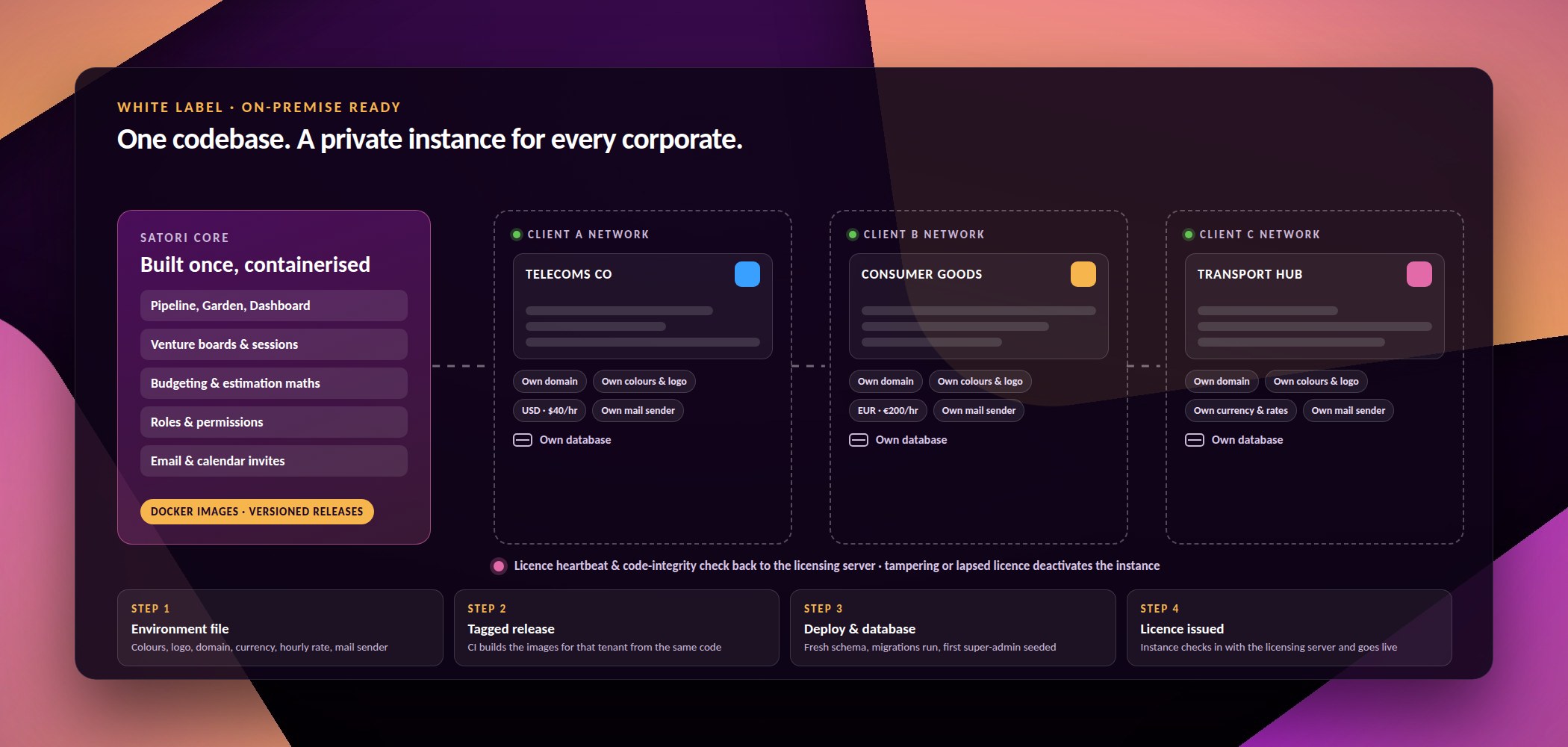
Everything tenant-specific lives in configuration rather than code: the domain, the logo, the colour palette, the mail sender, the currency and the default hourly rate the cost calculations run on. A tagged release builds that tenant’s images from the same source, deploys them against their own database, and seeds their first super admin.
Standing up a new corporate instance became a runbook rather than a project. That is what let OUTCOME say yes to a multinational asking for a branded demo, and have it live and populated with their own data within days.
Built for companies that won’t use someone else’s cloud
The organisations Satori is sold into run a security review before they run a pilot, and for good reason: an innovation pipeline is a list of everything the company is considering doing next, with the money attached. Plenty of them will not host that anywhere but their own network. That is why the application was containerised early rather than late — the same release that runs on managed hosting can be deployed inside a client’s own infrastructure, with its own isolated database and no dependency on services outside it.
A single hosted application, with every prospect’s security questionnaire pointing at the same answer.
A deployable release: same code, the client’s infrastructure, an isolated database, no shared tenancy.
Because the code leaves your hands in that model, we built in a licence mechanism: a periodic heartbeat to a central licensing server plus a code-integrity check. If the licence lapses or the code is modified, the instance deactivates. It let OUTCOME sell an on-premise product without giving the product away.
Four kinds of user, one set of data
A global corporate does not want everyone seeing everything. A team member sees their own project. A venture board member sees the projects assigned to their board. A business-unit admin sees their unit. A super admin sees the whole company and can filter it by unit, board or tag.
That is a permissions table, but it drives the entire interface: which navigation appears, which dashboards are populated, how far a filter can reach, and who receives the calendar invite when a checkpoint session is booked.
People who sit on several venture boards choose which hat they are wearing when they log in. It is a small thing that makes the product usable by exactly the senior staff these boards are made of, who are typically involved in four or five ventures at once.
Where it stands
Satori has been in continuous development with us since early 2023: the v2 rebuild, the white-label rollout to corporate instances, and a v2.1 that added budget carry-over, cost-saving estimates, actual revenue reporting and the funnel indicators prospects ask about first.
It is the second product we have built for OUTCOME, and the same pattern held both times: take something that already exists, understand the business logic behind it properly, then rebuild it so it can be sold rather than merely demonstrated.
Selling software into companies that won’t share a cloud?
White-label instances, per-tenant branding and configuration, on-premise deployment and licence enforcement. We build products that can be handed to a corporate client without being handed over.
.avif)