
AI Transport Planning & Custom CRM for Ecomotive
A vehicle delivery company with aggressive growth plans and a planning process that ran on people. We mapped the operation, then built the AI planner and the CRM it needed to scale.
A growth plan the process couldn’t carry
Ecomotive moves vehicles for its customers: a driver collects a car at one postcode and delivers it to another, driven or on a transporter, usually the next day. Every job has to be priced, planned, assigned to a driver and tracked to completion, and the business had two to three years of aggressive growth ahead of it.
We started with a digital transformation consultation rather than a software brief. Sitting with the business leaders, we mapped how a job actually moved through the company, where work was duplicated, where it bottlenecked, and which of those problems would get worse as volumes grew.
The findings pointed at two builds: an AI-driven transport planning system to take the manual work out of scheduling, and a custom CRM to hold every client, delivery and driver record in one place. The sections below cover what we built and why.
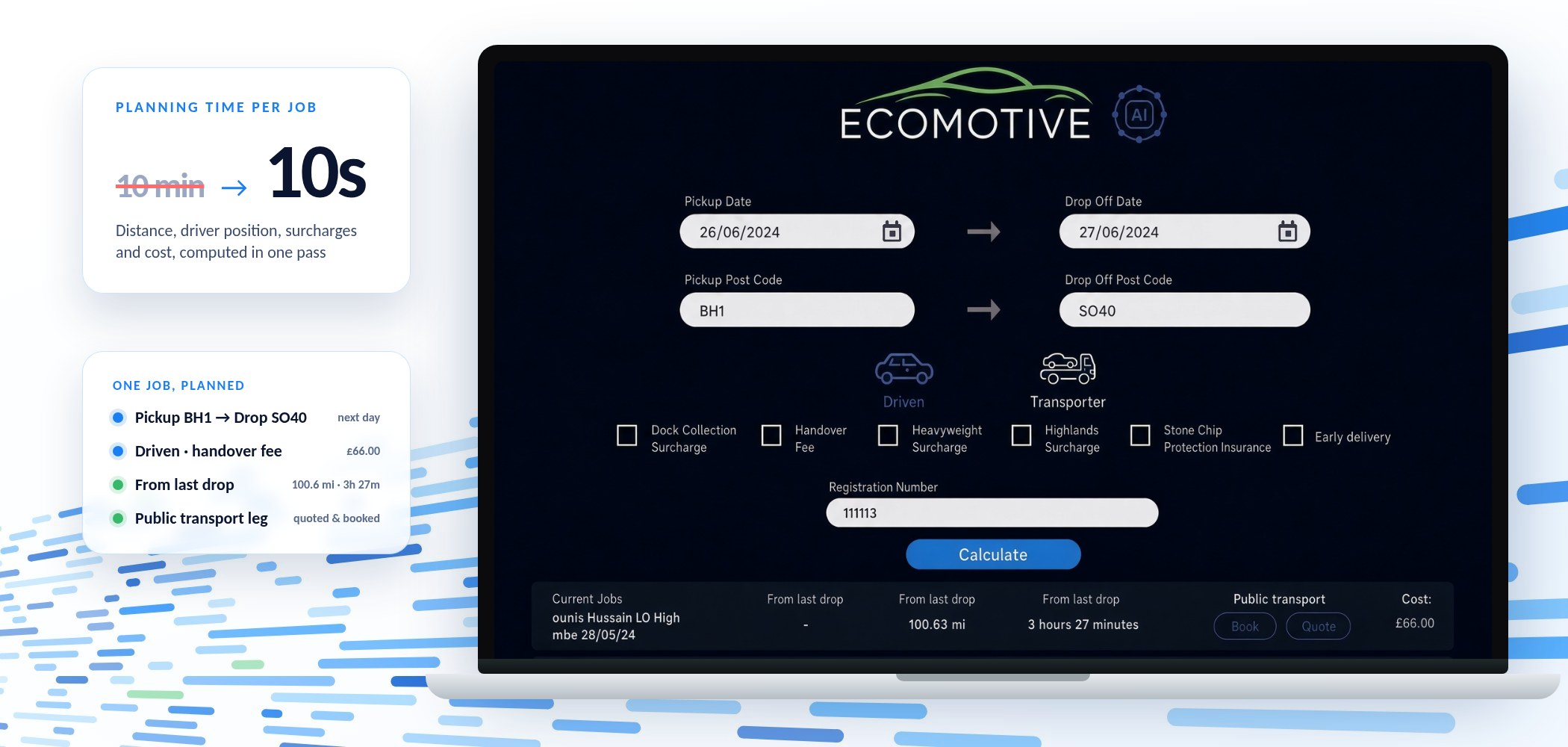
Ten minutes of planning, done in ten seconds
Planning a vehicle delivery is not one decision, it is a chain of them. Where is the car, where does it need to be, which driver is nearest when their current job ends, how do they get from the last drop to the next collection, and what does all of that cost. A planner working by hand took around ten minutes per job, and every job was a fresh set of lookups.
The AI-based planning system does that chain in about ten seconds. It takes the pickup and drop-off, the delivery type and the driver’s position after their last drop, works out distance, time and the public transport leg between jobs, and prices the job with the right surcharges applied. The planner reviews rather than researches.
after ~10 seconds per job · distance, time and cost computed · surcharges applied automatically
capacity thousands of jobs a day without adding planners
The system is built to handle thousands of jobs a day, which matters more than the per-job saving. Planning was the ceiling on how much work Ecomotive could take on; removing it turned growth from a staffing problem into a sales problem.
It also freed the operations team to work on the rest of the business. The efficiency that was promised in the consultation is the efficiency that was delivered, which is not something every AI project can say.
Pricing a job before anyone picks up the phone
A delivery quote has more moving parts than a mileage rate. Is it driven or on a transporter. Is there a dock collection surcharge, a handover fee, a heavyweight or Highlands uplift, stone chip protection, an early delivery premium. Get one wrong and the job loses money; take too long and the customer has gone elsewhere.
The calculator puts every one of those options on one screen with the pickup and drop-off postcodes, the dates and the registration, and returns a cost alongside the distance and travel time from the driver’s last drop. The public transport leg between jobs can be quoted and booked from the same row, so the true cost of a job includes getting the driver to it.
A quote worked out from experience and a rate card, with the driver’s travel between jobs estimated or forgotten.
Every surcharge, the delivery type and the driver’s onward travel priced together, in seconds, the same way every time.
One record for every delivery
Growth had made Ecomotive’s data more interconnected than its tools. A customer, a delivery and a driver were three records in three places, and keeping them in step was administration nobody was paid to do. The custom CRM puts them in one system: customers, deliveries, drivers and vehicles, with the schedule, issues and delivery log alongside.
A delivery opens as a single page: the job reference, pickup and drop-off with both addresses mapped, collection and delivery dates, the assigned driver and vehicle, and a status that moves from booked to collected to delivered. What used to be a phone call to find out is now a page to look at.
Because the CRM and the planner share the same records, a job planned in ten seconds becomes a delivery, a driver assignment and a customer history without anyone typing it in twice. That is where the administration time actually goes.
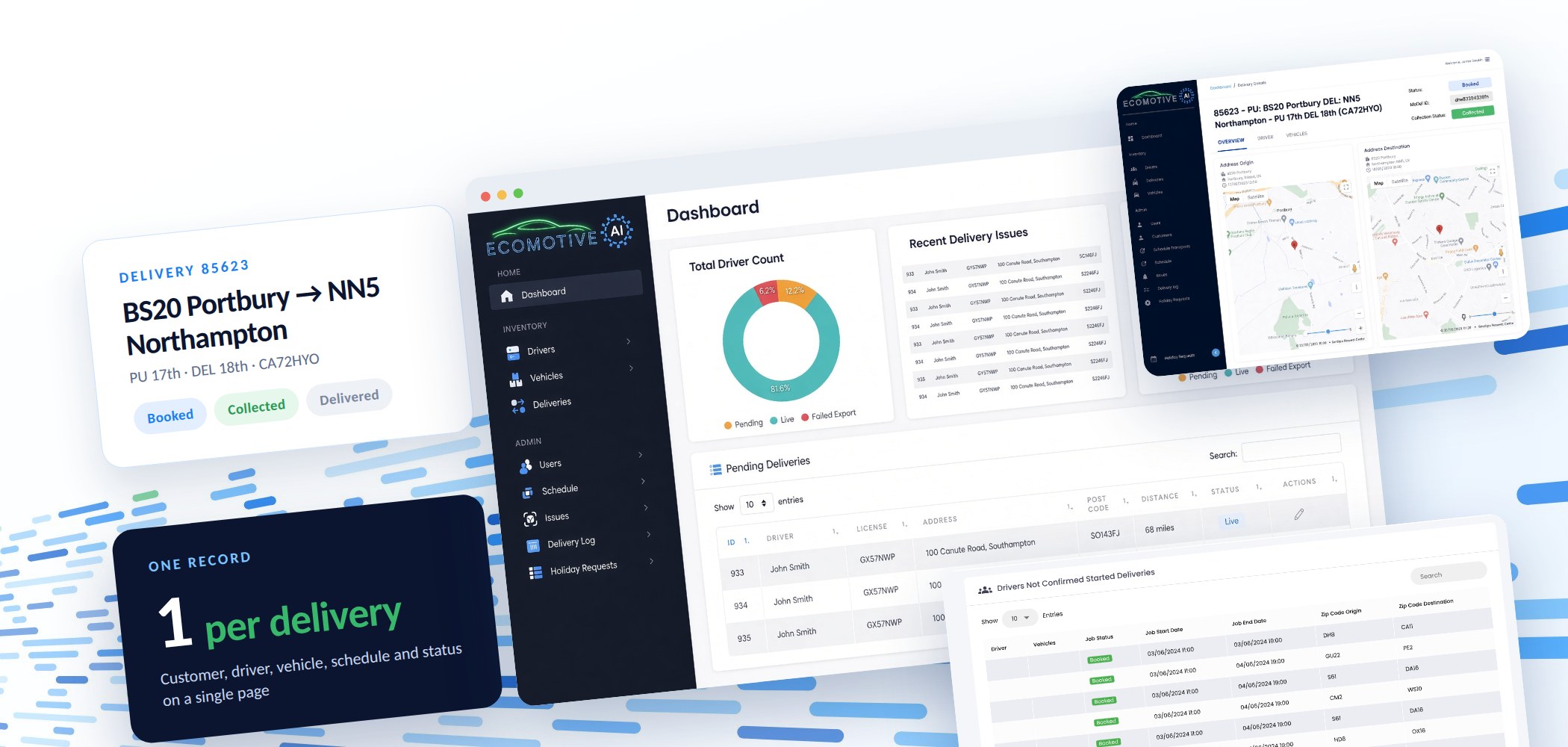
Seeing the problem before the customer does
The dashboard is built around exceptions rather than totals. Recent delivery issues, delivery status, pending deliveries and the drivers who have not yet confirmed they have started are surfaced on the first screen the operations team opens, filterable and searchable, so the morning starts with the jobs that need a decision rather than a scroll through the ones that don’t.
A late start discovered when the customer rang to ask where their car was.
Unconfirmed starts listed by driver, vehicle and job window on the dashboard, before the collection time has passed.
Holiday requests, schedules and transport scheduling live in the same admin area, so cover for a late start is arranged from the screen that flagged it.
Built for the company Ecomotive is becoming
The brief behind everything was scale. Ecomotive’s plans for the next two to three years needed a system that would not need rebuilding at twice the volume, so the analysis phase was spent finding duplication and bottlenecks that were tolerable then and would not be later.
That shaped the build: a planning engine designed for thousands of jobs a day rather than the current volume, and a CRM whose records are the single source for planning, dispatch and customer history rather than a copy of them.
The aim was to protect the margins the business already had while it grew, not to trade them for volume. Removing the manual planning step and the duplicated admin around it is how that was done.
Where it stands
The AI planning system is live and doing the job it was scoped to do. The CRM continues to grow with the business, and we remain Ecomotive’s technical partner as they establish themselves as leaders in their market.
It began as a conversation about growth, not software. Understanding the operation first is why the software that followed fitted it.
Growing faster than your processes can carry?
We start by mapping how your business actually runs, then build the systems that remove the bottlenecks: planning, pricing, records, reporting. Bespoke, and built for the size you are heading for.
.avif)