
Fire Safety Compliance Platform for RiskZen
A stalled first version taken over, re-architected and grown into the platform assessors use on site and building owners use to prove their buildings are compliant.
A first version that had stalled
RiskZen came to us with a product that already existed. A first version had been built by another agency, and it was not progressing: features slipped, costs did not, and the client could not see a route from what they had to what they had set out to build.
We started with the code, not the roadmap. A review of the existing application showed where the architecture would have failed under the projected number of users, and where it was costing more to run than it needed to. That review became the plan: the changes that had to happen before anything new was built, and the order to build the rest in.
Everything since has followed from that decision. The platform described below is the product the client originally set out to make. It just needed to be built so it could hold.
An assessment is a legal record, not a form
Fire and building safety in the UK is not one inspection. A residential block needs a fire risk assessment, a health and safety assessment, a survey of every fire door, and a rota of recurring checks on alarms, extinguishers, emergency lighting, smoke vents and escape routes. Each has its own frequency, its own checklist and its own legal weight.
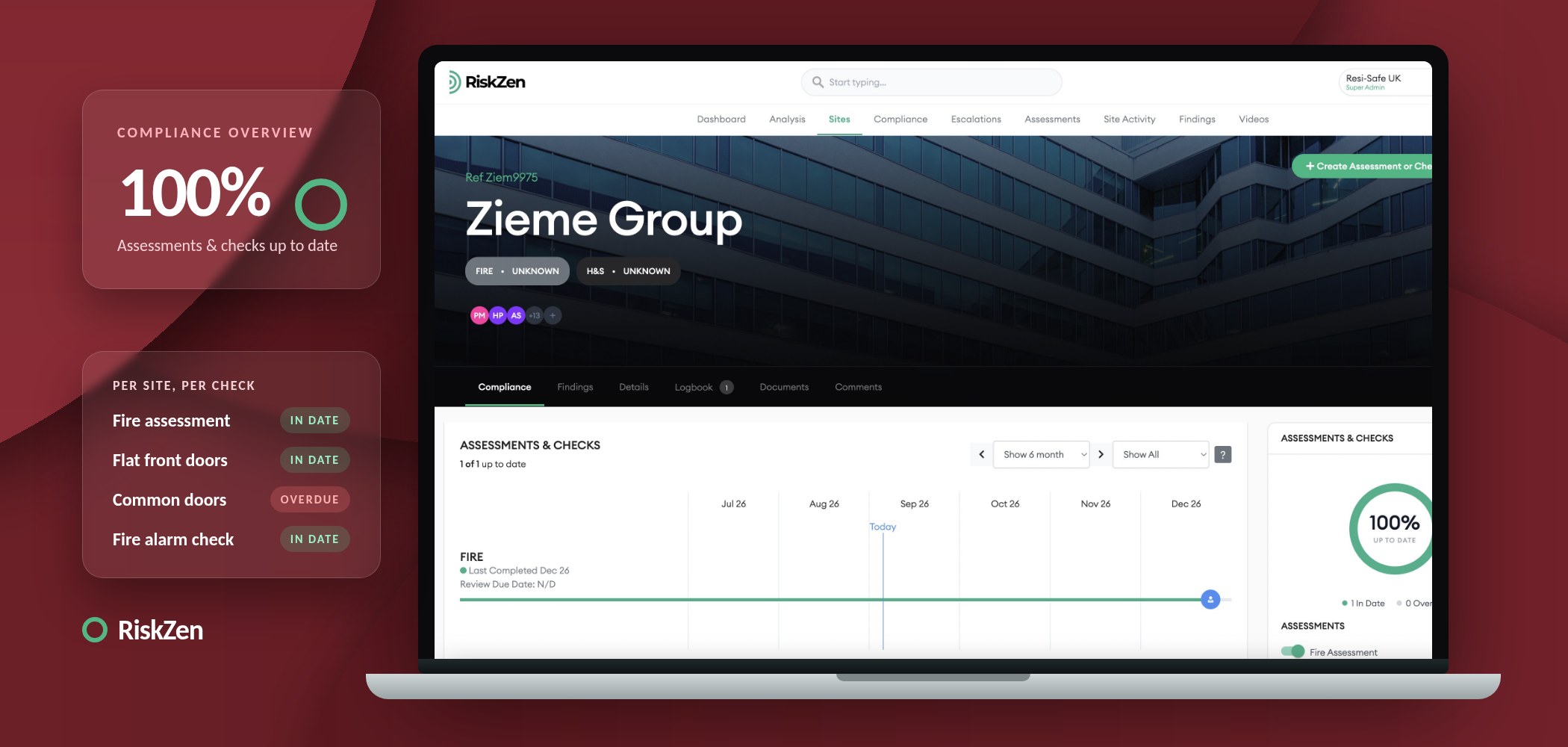
The data model had to carry that. A site holds its assessments; an assessment holds its findings, each with a rating, a location and the control required; and a compliance overview rolls those up per category so that a building manager can see, on one screen, what is in date and what is not.
door checks Full fire door survey · Flat front doors · Common doors
recurring checks Fire alarm · Extinguishers · Emergency lighting · AOVs & smoke control · Escape routes · EVC & refuge · Fire dampers
Site types matter too. Sheltered housing, a licensable HMO, a care home and a warehouse are assessed differently, and the checklists the assessor sees on site change accordingly.
Getting this right first is what made everything downstream possible. The mobile app, the reports and the scheduling all read from the same structure, so a finding recorded in a stairwell on a Tuesday is the same finding that appears in the PDF, on the dashboard and in the overdue list.
On site, in a stairwell, with no signal
Assessors work in plant rooms, basements and stair cores. Mobile signal is the exception, not the rule, and an app that needs a connection to save a photo is an app that gets abandoned for a clipboard.
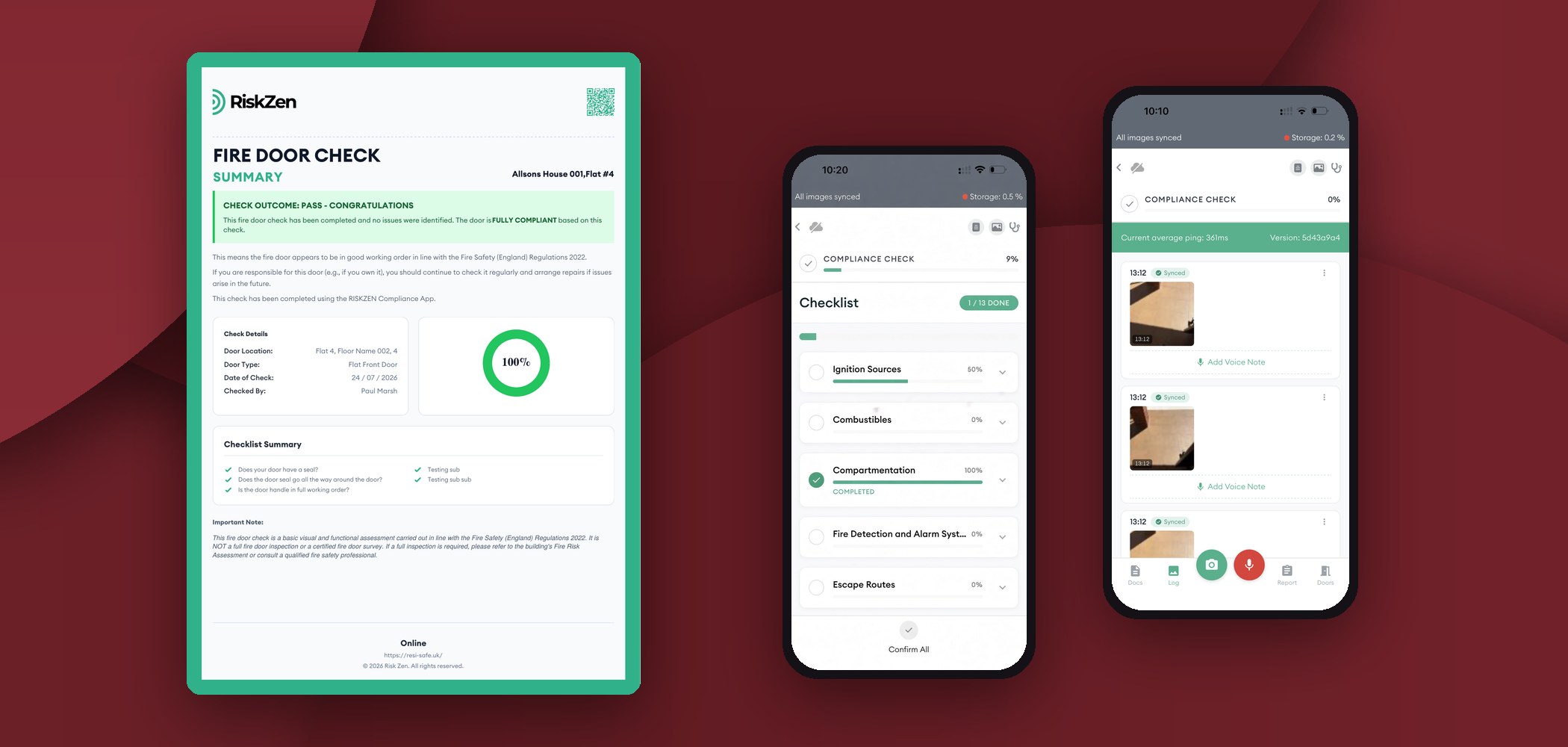
We built the assessor's app as a Progressive Web App that works fully offline on iOS and Android from one codebase. Checklists, photos and voice notes are captured and stored on the device, then synchronised to the platform when a connection returns. The assessor can see at a glance what has synced and how much local storage is in use; the office sees the assessment appear as it lands.
Findings on a clipboard, photos in the phone's camera roll, everything typed up back at the desk days later and matched to the right door from memory.
Checklist, photos and voice notes captured against the specific location while standing in front of it, offline, and on the desktop before the assessor has left the building.
The report is what the client actually pays for
Nobody buys a risk assessment for the assessment. They buy it for the document they can hand to a landlord, an insurer or a fire officer. So the report was designed as a product in its own right rather than a print-out of the database.
Every completed assessment and check generates a PDF automatically: the outcome up front, the details a reader needs to act on, the checklist behind it, and the regulation it was carried out under. A QR code links the paper copy back to the live record, so a report pinned to a noticeboard is never the only version.
The same structure scales from a single flat front door check to a full fire risk assessment across a block, because it is generated from the findings the assessor recorded, not re-typed from them.
Compliance is a calendar, not an event
A fire risk assessment is valid until it is not. Every assessment type has a review interval, extinguishers and alarms are checked on their own cycles, and a portfolio of a few hundred buildings has thousands of dates quietly counting down. We built scheduling into the platform so that each site carries its own review dates per assessment type, whether the work is done by the client's own team or by an external contractor. Sites due or overdue surface on the dashboard, and site visits are booked against the schedule and become assessments once completed.
Review dates in a spreadsheet, per building, chased by whoever remembered to look.
Every site carries its own dates; overdue work surfaces on the dashboard and to the client without anyone maintaining a list.
Validation sits in the same flow: a completed visit is submitted for validation, checked, and only then sent to the client, so what leaves the platform has been looked at twice.
Running it as a product, not a project
A platform that assessment companies and their clients both log into has to behave like a business, not a bespoke tool. Assessment organisations invite the property owners and managers they work for; collaborators comment on sites; findings become actions with owners and due dates.
We integrated payment processing so RiskZen could operate as a subscription product, added live chat so users get help inside the platform rather than by email, and put session-replay logging in place so that when something goes wrong we can watch what the user saw rather than guess from a description. Issues raise notifications to us the moment they happen.
That operational layer is invisible when it works, and it is most of what separates a demo from a product people pay for every month.
Where it stands
RiskZen is live and in continuous development under an ongoing contract. The current phase opens the platform up to AI agents: an integration layer that lets a building manager ask which sites are overdue, or an assessor book a site visit, through a conversational assistant rather than the interface, with the platform's own permissions deciding what each user can see and do.
The client's view is above. What we would add is that the product they set out to build exists, holds under real use, and has a route forward that the first version did not.
Someone else started it. You still need it shipped.
We take over stalled builds as a development partner: code review first, then the architecture, the features and the operational layer that turn a first version into a product people pay for.
.avif)