
Delivery Planning & Tracking Platform for Round Control
A product built from a founder’s brief into the system leaflet and magazine distribution businesses run on: plan the round on a map, track the drop, pay the distributor.
A brief with a number attached
Round Control’s founder came to us with a clear picture. Delivery companies in the leaflet and magazine trade plan drops to many thousands of addresses, hand them to distributors who walk them, and then have to prove delivery and pay everyone. Most of it ran on spreadsheets, printed maps and trust.
The product had to cover the whole chain: inventory in, areas planned on a map, rounds assigned, delivery tracked, proof kept, distributors paid. We planned and built it in stages, each one scoped against that brief and shipped before the next began.
Twelve and a half million drops later, it is the system the business runs on. The sections below are the parts that were hardest to get right.
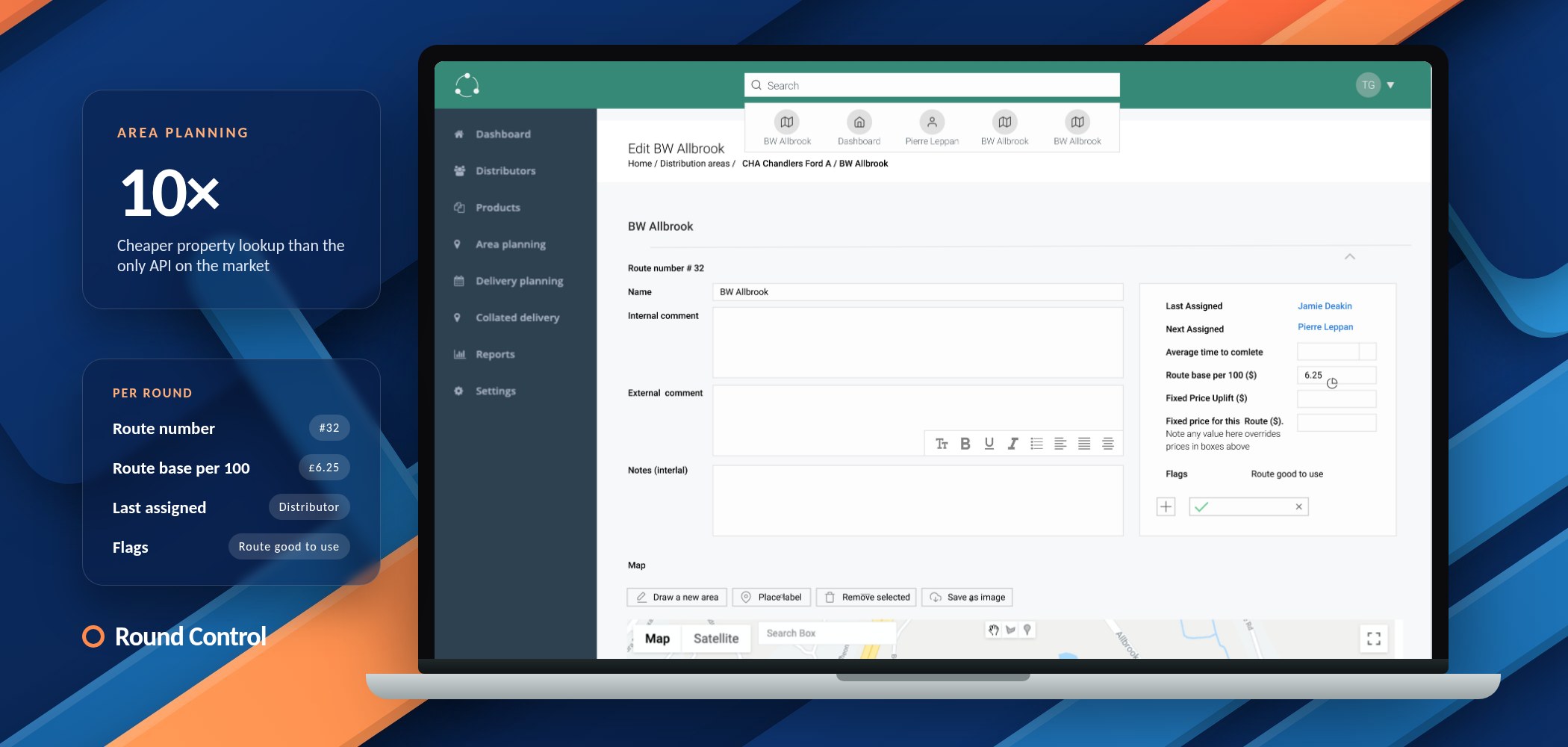
Draw an area, get every address inside it
The core interaction is simple to describe: a planner draws a shape on a map and the platform returns every property inside it, so the round can be priced and assigned. Simple to describe, not simple to build. When we started, exactly one API service could turn a drawn area into real property records, and it was priced for enterprises.
We built our own. Combining data from several sources with a custom matching algorithm, the platform resolves a drawn polygon to its addresses at roughly a tenth of the cost of the incumbent service, which is the difference between a feature that can be used on every round and one that has to be rationed.
as built multiple data sources · custom matching · ~1/10 the cost per round
outcome every round planned on the map, none rationed
Property counts drive everything downstream: how many items go out, what the distributor is paid, what the client is invoiced. Getting them cheaply is what let the rest of the product exist.
The same map layer carries the drawn areas, labels and saved images that go into the delivery instructions, so the planner in the office and the distributor on the pavement are looking at the same shape.
Tracking a walk, not a van
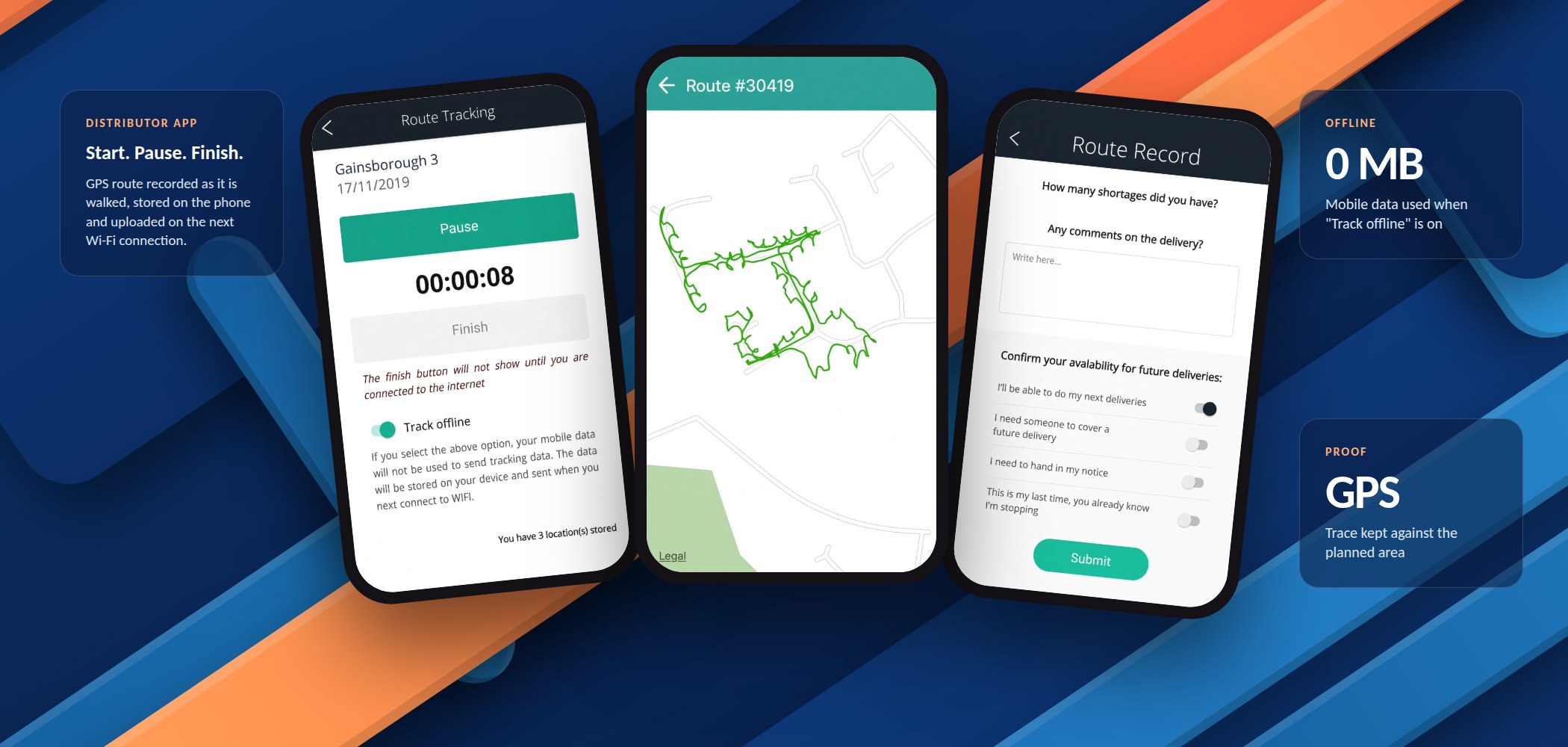
Leaflet distribution is done on foot, by people using their own phones, often in places with poor signal and on data plans they pay for themselves. A tracking app that drains data or demands a connection does not get used, and an app that does not get used proves nothing.
The distributor app works like a fitness tracker: pick the round, start, pause, finish. GPS points are recorded as the route is walked, and the distributor chooses whether to send them live or store them on the device and upload when they next reach Wi-Fi. The company sees the walked route drawn over the planned area, live or after the fact, and the record is kept.
A signed sheet saying the round was done, disputed weeks later when a client’s leaflets did not arrive.
A GPS trace of the route walked, street by street, against the area that was planned, kept for as long as the client needs it.
Closing the loop at the end of a round
When a round is finished the app asks the questions the office would otherwise chase: how many shortages, any comments, and whether the distributor can do their next rounds, needs cover, or is stopping.
Those answers land in the admin dashboard alongside the tracking and the latest messages from the app, so a recruitment or scheduling problem surfaces the same day rather than the next time a round goes unfilled.
Recent messages, recent tracking and product bookings sit on one dashboard, filterable by area and date. Small thing to build, large thing to run a distribution business without.
Paying hundreds of distributors without a spreadsheet
A distribution company pays a lot of people small amounts, often. The platform already knows who walked what and what each round is worth, so paying should not mean re-keying that into a bank. We integrated Open Banking so a company connects its business account and pays hundreds of distributors in a few steps, from the same records that prove the work was done.
A payment run assembled by hand from route records into a bank batch file, checked twice, still wrong sometimes.
Payments initiated from the platform, per distributor, per round, against the tracked record.
It is the part of the product customers say they would be lost without, which is the standard we set for it.
Reporting the round back to the client
Every detail of a delivery business is searchable, from route creation to payment. Reports export with drop-off instructions for drivers, maps, and the full details of each route, so the client who paid for the distribution gets evidence rather than assurance.
That report is the product’s commercial argument. A distribution company that can show a client where every leaflet went wins the next contract, and the one that cannot is competing on price alone.
The reporting layer reads from the same records as tracking and payments, so there is one version of what happened on a round, not three.
Where it stands
Round Control is a live business on the platform, with 12.5 million drops recorded, and we remain its technical partner under a service agreement: feature work, maintenance, and the changes that come as the business and its customers evolve.
It started as a founder’s brief. What we contributed is a system where the expensive problem was solved cheaply, the field data is trusted because it was captured as it happened, and the money moves from the same records.
You have the idea. You need it built to last.
We take founder briefs and build them into products: staged delivery, the hard technical problem solved early, and a partner who is still there when the business is running on it.
.avif)