
The Contracting Health Check Assessment
A global contracting body had a diagnostic that only worked when a consultant ran it. We turned the model into a public assessment any organisation can complete in ten minutes and get scored against its own industry.
A diagnostic that only worked when a consultant ran it
World Commerce & Contracting is the global body for commercial and contract management. Its research had long argued that weak contracting quietly erodes value from a business. Proving that to any individual member, though, meant a consulting engagement — and most organisations were never going to commission one just to find out whether they had a problem.
WorldCC and Deloitte had the model. What they wanted was a way to put it in front of a member on a Tuesday morning and give them a defensible answer before the coffee went cold, with the option to talk to WorldCC or Deloitte afterwards if the answer was uncomfortable.
We built the public assessment that does it: nine questions, a weighted scoring model behind them, and a benchmark that compares each organisation with everyone else in its industry. The sections below are the parts that mattered.
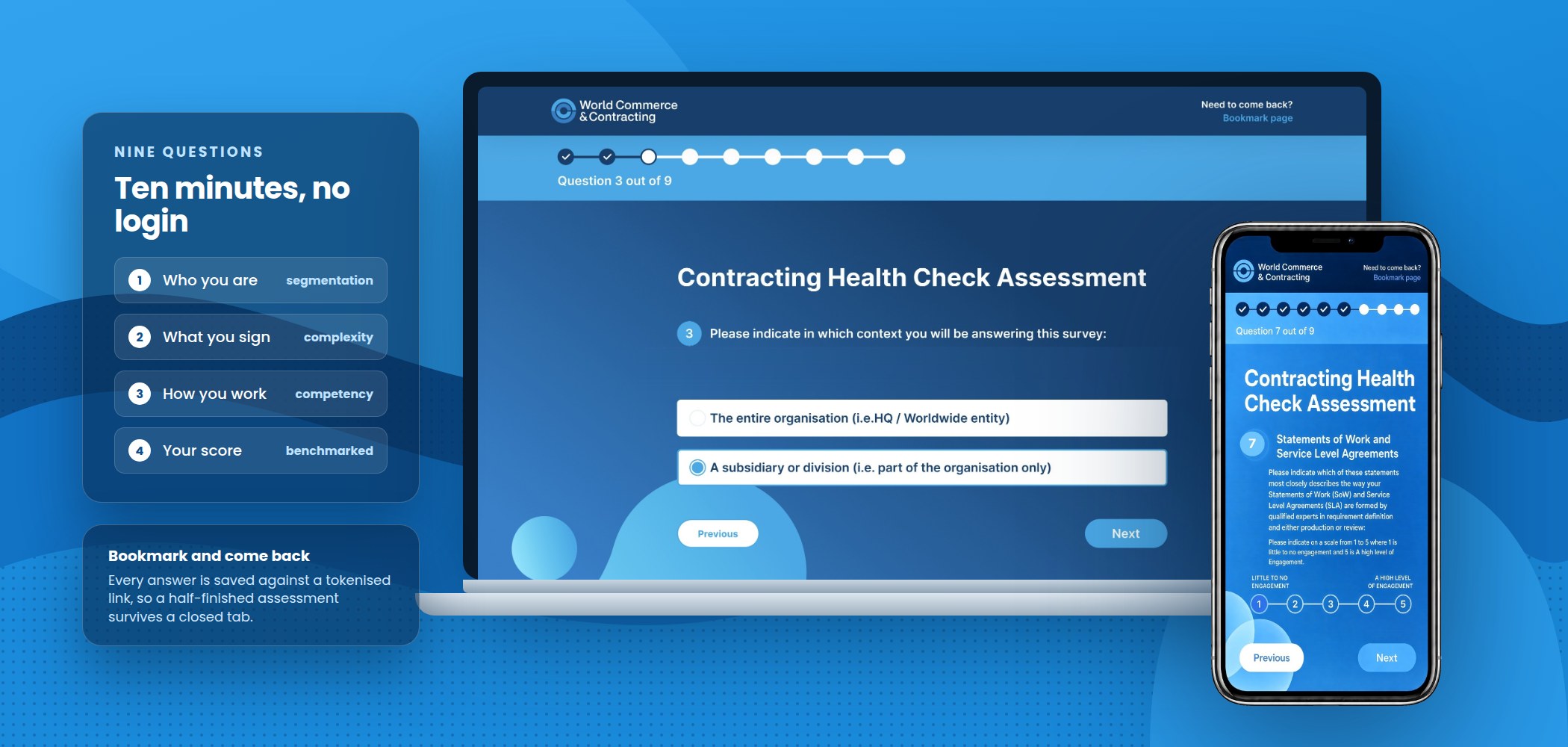
Ten minutes, on whatever was to hand
The audience here is senior commercial and legal people, and they were as likely to start this on a phone between meetings as at a desk. An assessment full of sliders and percentage splits that only behaved properly on a laptop would have lost most of them somewhere around question three.
So the flow was rebuilt to work at phone width throughout, and every answer is written against a tokenised link as it is given. The header carries a bookmark, which means an assessment interrupted by a meeting gets picked up rather than started again.
after a nine-step flow that fits a phone and saves as it goes
outcome a session interrupted by a meeting is resumed, not abandoned
Sliders, portfolio percentage splits and nought-to-four adoption scales all had to stay usable with a thumb, which is harder than it sounds when the answer is a proportion rather than a choice.
There is no login and no account. The assessment is reached by a tokenised link, which keeps it open to anyone and keeps the barrier at zero.
A spreadsheet model, rebuilt as a system
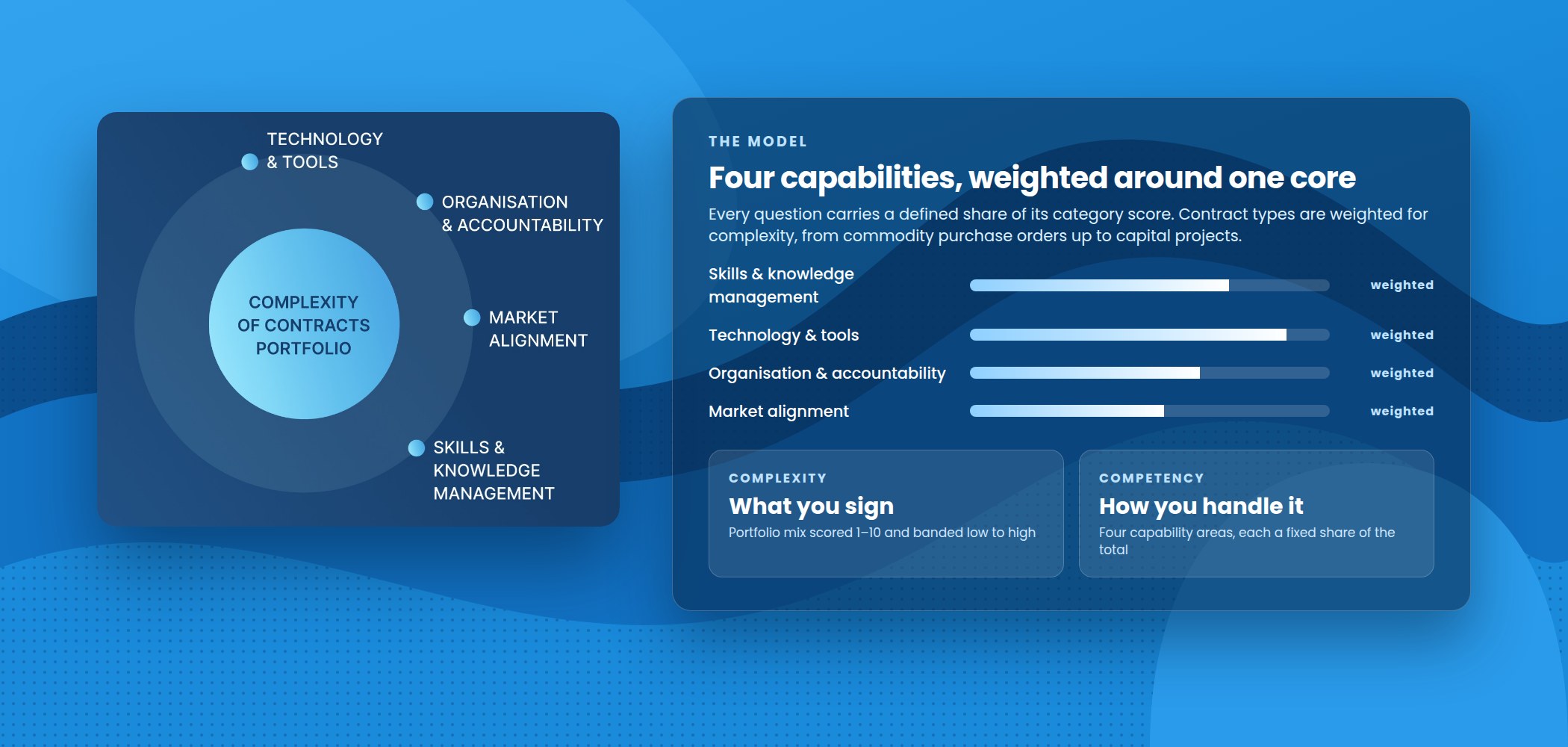
The interface was never the hard part. WorldCC's model gives every question a fixed share of its category score, scores each type of contract for complexity — commodity purchase orders at the bottom, capital projects at the top — and resolves the lot into two composite numbers: how complex your portfolio is, and how well equipped you are to handle it.
We built that model as configurable data rather than as code. Question weights, answer values and complexity scores all live in the admin, which mattered more than anyone expected: the model was retuned repeatedly as the research team and Deloitte worked through it, and not one of those changes needed a developer or a deployment.
A scoring model in a spreadsheet, applied by a consultant, one client at a time.
The same model running as a public web application, retunable in the admin without a release.
A score is only useful next to someone else's
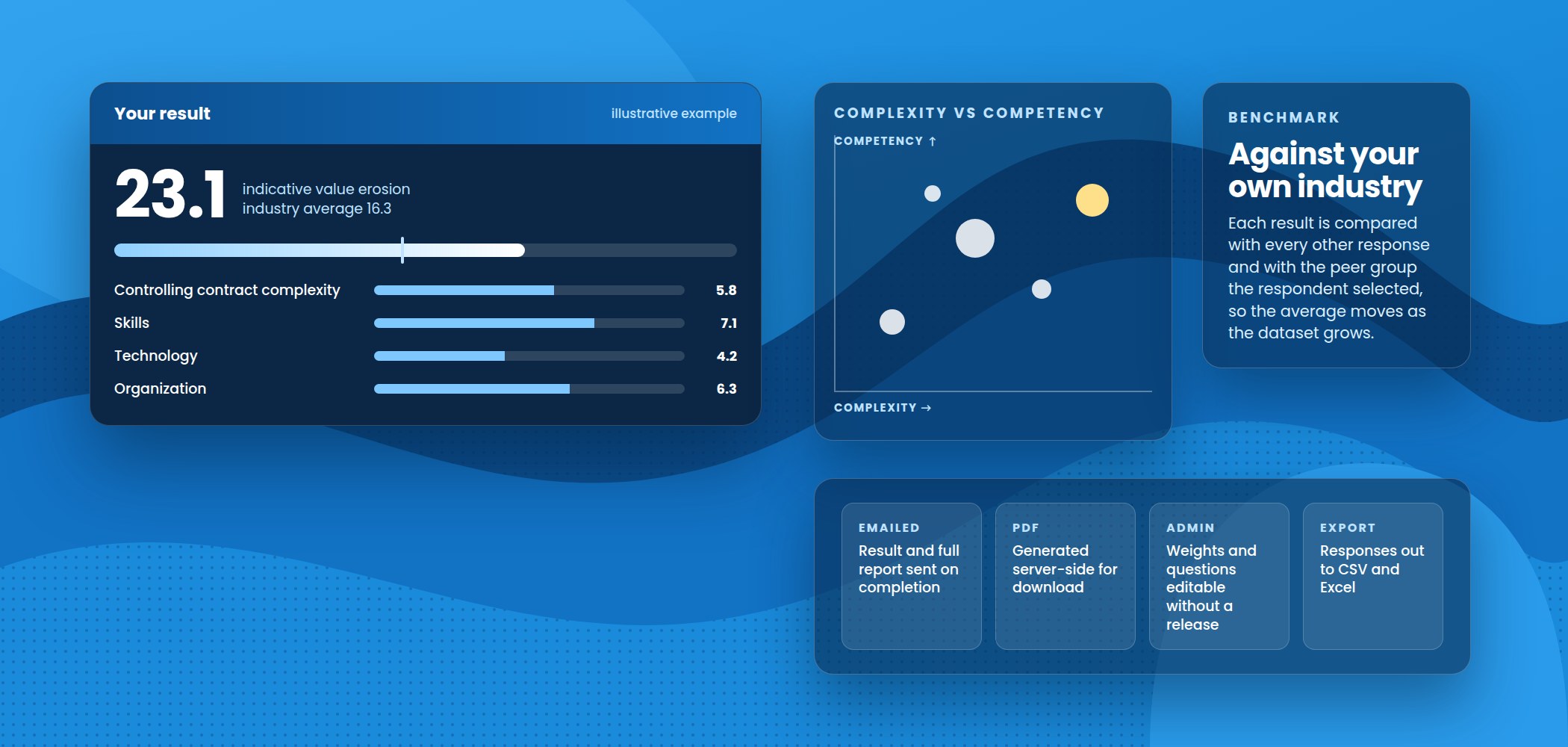
A number on its own tells an organisation nothing. Told that its contracting scores 23, a business has no idea whether to celebrate or panic. The assessment reports an indicative level of value erosion and then immediately sets it against two things: the average across every response collected, and the average for the respondent's own industry.
Those benchmarks are computed from live data rather than fixed at launch, so the comparison sharpens as the dataset grows. The first respondents were measured against a handful of peers; later ones against hundreds. Each capability area is also scored out of ten and reported separately, so the result points at where to look rather than just how bad things are.
The complexity-versus-competency view is the one people stop at: it shows whether an organisation is over-matched by what it signs, or comfortably on top of it.
Results that leave the browser
Most respondents want the number. The organisation that commissioned the assessment wants the evidence. On completion the platform emails the result out with the category breakdown and links through to WorldCC's research on the return from contracting excellence, generates the full report as a PDF server-side, and exposes every response to the WorldCC team as CSV and Excel exports.
A deck produced per engagement, weeks after the conversation that prompted it.
An emailed result on completion, a downloadable report, and a dataset WorldCC can analyse.
The export mattered more than anyone expected at the outset. It is what turned a member-facing tool into a research instrument for the body that built it.
A promise made to every respondent
Organisations were being asked to say, in a web form, how well they actually manage their contracts. That is not a comfortable thing to disclose, and an assessment nobody answers honestly is worth nothing. WorldCC's answer was an explicit promise on the page: individual assessment data stays confidential and goes no further than WorldCC. No unsolicited calls, no follow-up.
That promise shaped the build. The assessment is anonymous and tokenised rather than account-based, so there is no login and no profile to mine. Benchmarks are computed in aggregate, never by exposing an individual response. Only WorldCC administrators can reach the raw data, behind role-based access.
It is the kind of constraint that reads like a footnote in a brief and turns out to be the reason the data is any good.
Where it stands
The Contracting Health Check went live in April 2023 and is still running. WorldCC has since brought hosting in-house, and we continue to work with them on it and on the wider set of tools their members use.
It sits alongside the contract maturity assessment and the software comparison tool we also built for them — a set of systems that exist to make WorldCC's research usable by the organisations it is about.
Got a model that only works when an expert runs it?
Scoring models, diagnostics and assessments live in spreadsheets and in consultants' heads far more often than they should. We turn them into something your audience can run on their own, and that gives you the data back.
.avif)